
Category Archives: Choral Evensong Blog

Choral Evensong Blog: Sunday 3rd February, 6.30pm

The carol books are packed away until the end of the year and we return to a pattern of first Sunday choral evensongs, starting on Sunday 3rd February. This will be celebrated as Candlemas or The Presentation of Jesus at the Temple: the actual date of the feast is 2nd February.

Johannes Eccard

Our very appropriate anthem is ‘When to the temple Mary went’ by Johannes Eccard. I would hazard a guess that anyone who has ever been a chorister would know this piece well, but would be unable to name another work of Eccard. Further, it is likely that this piece is better known in England than it is in Germany. Why? Because this piece is representative of a nineteenth-century vogue for translating continental pieces for use by the choirs and choral societies of the day. The Revd John Troutbeck, who translated Eccard’s ‘Maria wallt zum Heiligtum und bringt ihr Kindlein dar’ (no, I’d never come across this before, either!), also translated Bach’s passions into English, and it’s worth remembering that it’s only in the last 50 years that German has overtaken English as the norm for these pieces – and do we hear them as often? As for the Eccard, it’s possible that no other piece has been so frequently sung on one specific date in Anglican churches in the last 150 years.

It’s a wonder that John Troutbeck (1832-1899) found any time for his day job as Precentor, first in Manchester and later at Westminster Abbey, because his translations included works by almost every major composer, including many operas, and he also compiled a number of hymn books and chant books. In my opinion, Troutbeck made a very good job of the Eccard translation. Where Eccard had two verses with a repeated chorus, Troutbeck changed the words of the second chorus to make a more complete summation of the text, which is, of course, a free version of the Nunc Dimittis.

What, then, of Eccard (1553-1611)? His career was as a court musician, largely in the service of the Margraves of Brandenburg-Ansbach, firstly in Königsberg and later in Berlin, where he became Kapellmeister. This was a time of great development of Protestant German music and most of Eccard’s compositions are based on the chorale, some extensive, others like the current piece simple harmonisations of a chorale-like melody. He favoured rich textures and ‘When to the temple’ is in six parts, two sopranos and two basses, the latter creating depth in the sonority.
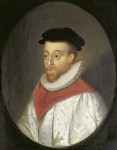
Orlando Gibbons

The responses will be my own recently completed setting using the music of Orlando Gibbons, who left only the opening preces. The psalm attached to these preces has been used as the source for a setting of the Lord’s Prayer and the second part of the responses.

We sing the canticles of Richard Farrant in G minor. There were a number of musicians by the name of Farrant in the sixteenth century, at least two Johns, a Daniel and Richard (c1530-1580). There is some confusion over the attribution of music between them, but Richard is the most significant figure. He held posts at Windsor and the Chapel Royal and wrote several plays, none of which survives, for companies that he set up primarily for his singing boys.

As a composer he is best known for two anthems, ‘Call to remembrance’ and ‘Hide not thou thy face’, and this service, described in Grove’s Dictionary as ‘High’ or ‘Third’ service, which suggests that it isn’t only his plays which are no longer with us. These three pieces owe their popularity to their inclusion in Boyce’s Cathedral Music (1760-1773), which was for some time the major source of repertoire for English cathedrals. It was Boyce who first established the key of G minor for this service despite earlier sources written a tone higher, and it is in G minor that we shall sing it. It is written in the style of a ‘short’ service, that is with little word repetition and a largely chordal texture. But the dramatist in Farrant found expressiveness in the antiphonal exchange of short phrases between the two sides of the choir.

The organ voluntary is the Prelude in C minor op.37 no.1 by Felix Mendelssohn, who was a fine organist and already writing music for the instrument at the age of eleven. It was almost inevitable that his organ music would be greatly influenced by his rediscovery of the music of Bach, and many of his works are preludes, fugues and other contrapuntal exercises, or works based on chorales. The Prelude in C minor of 1841 looks back to the baroque. It consists of a running quaver figure, which works through all the parts and at times invades the pedal part requiring nimble footwork, set against a slow moving harmonic background with complex Bach-like harmonies.

Damian Cranmer
Choral Eucharist for the Feast of All Souls: 4th November 2018, 6.30pm

This article is the latest instalment of the Choral Evensong Blog, giving an insight into the history of and background to music sung by the choir at our monthly Choral Evensong services.  Click here to read all previous instalments of the blog.


Some of you may already have in your diaries Andrew Green’s talk on Tuesday 20 November on Vaughan Williams short opera The Shepherds of the Delectable Mountains. If not, put it in straightaway! More details here

Andrew Green will be talking about his conviction that (though not stated publicly by the composer) the piece is a memorial to those who died in the Great War. The text of the opera is largely adapted from John Bunyan’s allegory of 1678 The Pilgrim’s Progress from This World, to That Which Is to Come, which was hugely popular at the time of the Great War. Some of us have heard Andrew’s talk before, and we can promise a moving, intriguing and fascinating evening, just a few days after the centenary of the Armistice. The evening will include the playing of a recording of the whole opera. But don’t worry, it is not a work of Wagnerian proportions, and lasts just over half an hour.

It occurred to Kathy Goodchild that movements from this work and Vaughan Williams’s later and longer opera The Pilgrim’s Progress (of which The Shepherds forms a part) would adapt well into a service for All Souls. She has therefore arranged four movements for choir, organ and viola (to be played by choir member and webmistress Kate Ford).

The Introit and motet after the commemoration of the departed are from ‘Watchful’s Song’ of The Pilgrim’s Progress, including words from Psalms 31, 127 and 121 and Isaiah 11 and 14.

Into thy hands O Lord, I commend my spirit.

Except the Lord keep the house, the watchman waketh in vain. The Lord hath poured out upon you the spirit of deep peace: the whole earth is at rest and is quiet.

I will lift up mine eyes unto the hills from when cometh my help. My help cometh even from the Lord who made heaven and earth. He will not suffer thy foot to be moved. He that keepeth thee shall not sleep. Behold he that keepeth thee shall neither slumber nor sleep. The Lord himself is thy keeper, he shall preserve thee from all evil: yea it is even he that shall keep thy soul from this time forth for evermore

The Gradual is from The Shepherds of the Delectable Mountains, and sets words from Psalm 91:

Whoso dwelleth under the defence of the most high shall abide under the shadow of the Almighty. He shall defend thee under his wings, and thou shalt be safe under his feathers. He shall give his angels charge over thee, that thou hurt not thy foot against a stone.

To this the Requiem words have been added:

Requiem aeternam dona eis Domine, et lux perpetua luceat eis   (Give them eternal rest O Lord, and let light perpetual shine upon them)

The anthem, taken from The Shepherds of the Delectable Mountains sets words from Psalm 23

The Lord is my shepherd, therefore can I lack nothing. He maketh me to lie down in green pastures, he leadeth me beside the still waters, he restoreth my soul, he leadeth me in the paths of righteousness for his Name’s sake. Yea though I walk thro’ the valley of the shadow of death I will fear no evil, for thou art with me, thy rod and thy staff they comfort me. Surely goodness and mercy shall follow me all the days of my life and I will dwell in the house of the Lord for ever.

We hope that this music will give solace to the bereaved in 2018 just as it did after the Great War.

Jonathan Goodchild

Choral Evensong Blog: Festal Evensong for Harvest, 7th October 2018

We’ll begin this service with a new introit by Kathy Goodchild “dedicated to the memory of Mary-Jane Boffey”, a member of our choir who sadly died this year. The words ‘Lead us, O God’ were chosen by Kathy specifically with Harvest thanksgiving in mind, and are by George Appleton (1902-1993), an important writer for the Anglican church, whose wide-ranging career included spells as Archdeacon of Rangoon and of London, and Archbishop of Perth, Australia, and of Jerusalem.

The responses will be those by Philip Radcliffe (1905-1986), who went to King’s College, Cambridge as an undergraduate, was appointed a Fellow in 1931 and pretty well never left. He was primarily a teacher and critic but was an enthusiastic composer, whose style was described in The Times obituary as ‘Vaughan-Brahms’. His responses were written between Good Friday and Easter Day in 1972 for Edington – flash of inspiration, last minute activity or well in advance of commission for annual August Festival? They include a full Gloria and a setting of the Lord’s Prayer.

The canticles will be sung to Wood in D. Charles Wood (1866-1926) was born in Armagh and received his early education at the cathedral school and in the cathedral choir there. At the age of 17, he was awarded a scholarship to the Royal College of Music, where he studied composition with Parry and Stanford, with whom he was later to work in Cambridge. It should be no surprise, then, that Anglican church music played an important part in his life, and, although he wrote in other forms, it is by his church music that he is known today. What is surprising to me is that he wrote so many settings of the Magnificat and Nunc Dimittis – 13 in all, with two additional Latin settings of the Nunc. In my July article I could think only of Weelkes (9 settings) as the closest to Howells (21). I might have remembered that Wood is one (I’d better not say the only) composer with two settings in the same key (E flat) which have to be identified as no.1 and no.2. Wood’s 13 settings include two on Gregorian tones, one on the Genevan Psalter, a metrical version to a Sternhold and Hopkins text, and two for double choir.

Wood in D is the second of his settings, dating from 1898. It follows very much in the Stanford tradition: important organ part with dramatic interruptions, strong unisons, word painting (He hath put down), wide modulations, and contrasted quieter sections. Whether Wood intended it or not, the opening of the Gloria bears a strong likeness to the grave of Bach’s Fantasia in G BWV572. If he did intend it, it is not a cause for censure. There exists a long tradition of acknowledging another composer’s work in a new composition. The sixteenth century abounds with ‘parody’ masses paying tribute to earlier works, Bach and Handel borrowed extensively, almost always with interest, and there are numerous later examples. The Nunc Dimittis ingeniously contrasts the melody in the basses with pianissimo reflections in the upper three parts, before repeating the Gloria of the Magnificat.

Our anthem is ‘Sing, O heavens; and be joyful, O earth’ by Lloyd Webber. Written in 1957, this is, of course, William (1914-1982), who at that time had no need to distinguish himself from his illustrious sons. 1957 comes at the end of Lloyd Webber’s most fruitful compositional period, after which he turned to teaching, becoming Principal of the London College of Music. The text of the anthem, most appropriate for Harvest, is from Isaiah, chapters 49 and 51. What I haven’t been able to discover is who the recipient of this piece was, because that might explain why there is no tenor part. We’ll have to make sure that our tenors don’t go off in a sulk; perhaps they could sing along with us basses! What is clear is that Lloyd Webber was skilful in 3-part writing. (The absolute master of this was Purcell.) The texture changes from unison to full harmony, with several solo and imitative sections. The independent organ part secures the lowest note of the harmony, so that the basses at times can leave their natural role and act as quasi-tenors.

The closing voluntary is Mendelssohn’s ‘War March of the Priests’ (Kriegsmarsch der Priester) from his incidental music to Racine’s play Athalie. If you want a quick summary of why the priests are on a war march (and I did), go to Wikipedia. Alternatively, the story can be found (and I’m extremely grateful that we’ve inherited my mother-in-law’s concordance!) in 2 Kings chapter 11 and 2 Chronicles chapter 22. Even if you don’t recognise any of the above, you may well recognise the piece. It is based on one of Mendelssohn’s characteristic melodies. I hope the Redbourn organ is up to the organist’s war-like intentions!

Damian Cranmer