All posts by KFord

Article: A Church at the Heart of Every Community

I don’t know about you but whenever I visit a place, I nearly always pop into the local church. When we were in Amsterdam after New Year, to my family’s frustration, we’d end up inside some church or other. And when I’m at home and spending time around St Mary’s (praying, filling in paperwork, setting up for a service or even walking the dog) I nearly always meet someone passing by who has popped in for a moment of quiet, or to tend a grave, or to have a look round. I always love reading the comments in our visitors’ book and seeing who has come to have a look and where they are from.

Of course a church is more than bricks and mortar. It is a community of people who, together, live in relationship with God through Jesus Christ. There is a church at the heart of every community. And each one puts its faith in action. Churches locally run food banks and offer debt counselling, host groups and classes, offer pastoral care and bereavement support, serve meals or deliver them, and so much more.

Our churches belong to everyone. The buildings are often one of the oldest buildings in the community, and in many rural areas they are quite often the only community building. These communities often use their churches in imaginative and creative ways.

I know of a church where they don’t have a hall so they run all sorts of groups and activities, including a play group in the church during the week. There’s a village not far from here that was about to lose its Post Office and the church stepped in and runs it from the church building along with a small village shop. Some may find these other uses a challenging concept but throughout Christianity our churches have always been used in a variety of ways. In fact, many of the early Christian communities mentioned in the Bible met in people’s homes, until they grew too large and a dedicated building was needed.

Which leads us to the spiritual side of our church buildings.

When you call into a church, just think about the number of prayerful people who have stepped over the threshold over the years, and all the prayers of the faithful that have helped create the special atmosphere that we often sense when we step inside.

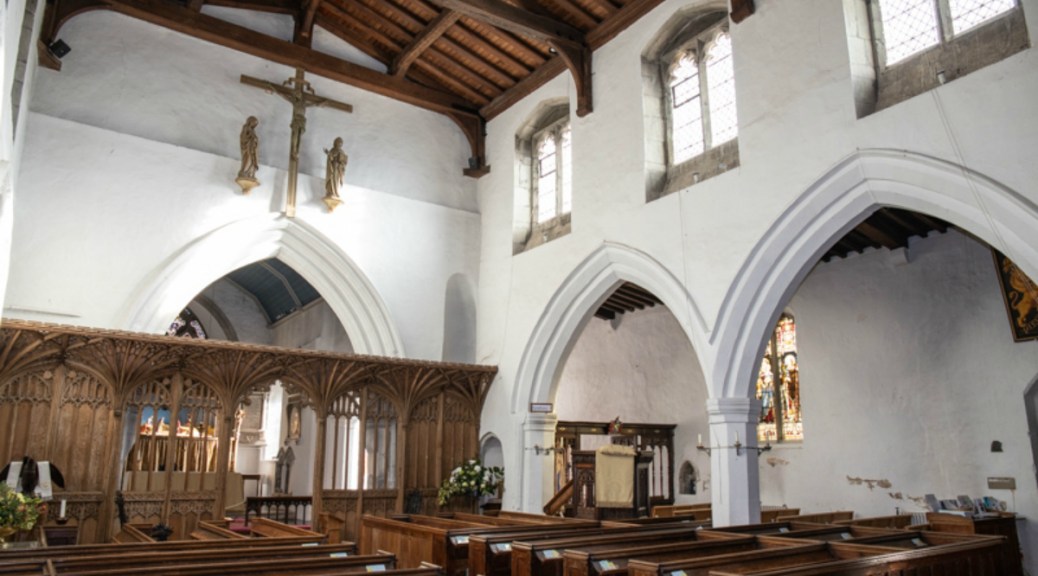
St Mary’s is open every day and we have an easy-to follow leaflet that offers a short walking tour round the building – pointing out some of the history and the key features that you can see. But if you call in, and we hope you will, as well as looking at the history and architecture, you might like to treat it as way of having a quiet meditative tour around the church. You may like to think about the following as you do.

The doors – are a symbol of God who welcomes each one of us into God’s presence.

The font – the starting point for many people on their journey of faith – what might you want to start afresh by leaving behind?

The pulpit – there may not be anyone preaching when you visit a church, but listen in the silence for God’s voice.

The aisle – imagine the thousands of people who have walked here before you. Some come weekly, some come for those moments on life’s journey – to bring their child for christening, to be married or to say farewell to a loved one. All those life stories in this one place.

The walls, pillar and roof – think how long they have stood there, solid and strong. Imagine the storms they have withstood. For centuries people have come to church to find shelter and refuge from the storms of life. You may be feeling battered by life’s storms at the moment. Pray for God’s protection and peace.

A Prayer      

God of our journey, we thank you for your church throughout the ages.

Thank you for all those people who have walked the journey before us.

Thank you for the community of faith that gathers here week by week,

and who share your love within our community.

Help us to know your presence with us,

both inside this building and alongside us day by day.

Amen.                                                         

Will

The Revd Will Gibbs,  Vicar – St Mary’s Church, Redbourn


Choral Evensong Blog: Sunday 3rd February, 6.30pm

The carol books are packed away until the end of the year and we return to a pattern of first Sunday choral evensongs, starting on Sunday 3rd February. This will be celebrated as Candlemas or The Presentation of Jesus at the Temple: the actual date of the feast is 2nd February.

Johannes Eccard

Our very appropriate anthem is ‘When to the temple Mary went’ by Johannes Eccard. I would hazard a guess that anyone who has ever been a chorister would know this piece well, but would be unable to name another work of Eccard. Further, it is likely that this piece is better known in England than it is in Germany. Why? Because this piece is representative of a nineteenth-century vogue for translating continental pieces for use by the choirs and choral societies of the day. The Revd John Troutbeck, who translated Eccard’s ‘Maria wallt zum Heiligtum und bringt ihr Kindlein dar’ (no, I’d never come across this before, either!), also translated Bach’s passions into English, and it’s worth remembering that it’s only in the last 50 years that German has overtaken English as the norm for these pieces – and do we hear them as often? As for the Eccard, it’s possible that no other piece has been so frequently sung on one specific date in Anglican churches in the last 150 years.

It’s a wonder that John Troutbeck (1832-1899) found any time for his day job as Precentor, first in Manchester and later at Westminster Abbey, because his translations included works by almost every major composer, including many operas, and he also compiled a number of hymn books and chant books. In my opinion, Troutbeck made a very good job of the Eccard translation. Where Eccard had two verses with a repeated chorus, Troutbeck changed the words of the second chorus to make a more complete summation of the text, which is, of course, a free version of the Nunc Dimittis.

What, then, of Eccard (1553-1611)? His career was as a court musician, largely in the service of the Margraves of Brandenburg-Ansbach, firstly in Königsberg and later in Berlin, where he became Kapellmeister. This was a time of great development of Protestant German music and most of Eccard’s compositions are based on the chorale, some extensive, others like the current piece simple harmonisations of a chorale-like melody. He favoured rich textures and ‘When to the temple’ is in six parts, two sopranos and two basses, the latter creating depth in the sonority.

Orlando Gibbons

The responses will be my own recently completed setting using the music of Orlando Gibbons, who left only the opening preces. The psalm attached to these preces has been used as the source for a setting of the Lord’s Prayer and the second part of the responses.

We sing the canticles of Richard Farrant in G minor. There were a number of musicians by the name of Farrant in the sixteenth century, at least two Johns, a Daniel and Richard (c1530-1580). There is some confusion over the attribution of music between them, but Richard is the most significant figure. He held posts at Windsor and the Chapel Royal and wrote several plays, none of which survives, for companies that he set up primarily for his singing boys.

As a composer he is best known for two anthems, ‘Call to remembrance’ and ‘Hide not thou thy face’, and this service, described in Grove’s Dictionary as ‘High’ or ‘Third’ service, which suggests that it isn’t only his plays which are no longer with us. These three pieces owe their popularity to their inclusion in Boyce’s Cathedral Music (1760-1773), which was for some time the major source of repertoire for English cathedrals. It was Boyce who first established the key of G minor for this service despite earlier sources written a tone higher, and it is in G minor that we shall sing it. It is written in the style of a ‘short’ service, that is with little word repetition and a largely chordal texture. But the dramatist in Farrant found expressiveness in the antiphonal exchange of short phrases between the two sides of the choir.

The organ voluntary is the Prelude in C minor op.37 no.1 by Felix Mendelssohn, who was a fine organist and already writing music for the instrument at the age of eleven. It was almost inevitable that his organ music would be greatly influenced by his rediscovery of the music of Bach, and many of his works are preludes, fugues and other contrapuntal exercises, or works based on chorales. The Prelude in C minor of 1841 looks back to the baroque. It consists of a running quaver figure, which works through all the parts and at times invades the pedal part requiring nimble footwork, set against a slow moving harmonic background with complex Bach-like harmonies.

Damian Cranmer

St Mary’s Charity of the Year 2019 Announced

We are delighted to announce that our St Mary’s Charity of the Year for 2019 will be YouthTalk.

YouthTalk is a charity based in St Albans which offers professional counselling to 13-25 year olds in the District of St Albans. Such support has been shown to be effective in tackling a wide range of issues from family and school problems to depression, eating disorders and other mental health problems.

We are constantly reminded of the pressures placed on young people’s mental wellbeing by the modern world, particularly social media which exerts levels of peer pressure unlike any faced by previous generations. Research shows that one in four of today’s young people are likely to suffer with a mental health issue in their lives, and many suffer in silence.

YouthTalk provides a safe, confidential space for them and also provides information services to parents, carers and schools.


We have a full programme of fundraising activities planned throughout the year, including:

  • Carols & Beer in December 2018 which began our fundraising for YouthTalk by raising £1113 – many thanks to the Cricketers and all those who donated on the night.
  • Photography Workshops at St Mary’s from which 100% of proceeds will be donated to YouthTalk – click here for further details or to book a place on one of the workshops
  • A Bluebell Afternoon Tea in late April – further information will be available nearer the time
  • A Variety Concert
  • plus more events and fundraising initiatives throughout the year

Can you help?  Perhaps you could:

  • Undertake a sponsored challenge in aid of YouthTalk?
  • Volunteer to help at some of the events above?
  • Make a donation via our online fundraising page?

Please get in touch for further information or to volunteer to help in some way.