All posts by KFord

Choral Eucharist for the Feast of All Souls: 4th November 2018, 6.30pm

This article is the latest instalment of the Choral Evensong Blog, giving an insight into the history of and background to music sung by the choir at our monthly Choral Evensong services.  Click here to read all previous instalments of the blog.


Some of you may already have in your diaries Andrew Green’s talk on Tuesday 20 November on Vaughan Williams short opera The Shepherds of the Delectable Mountains. If not, put it in straightaway! More details here

Andrew Green will be talking about his conviction that (though not stated publicly by the composer) the piece is a memorial to those who died in the Great War. The text of the opera is largely adapted from John Bunyan’s allegory of 1678 The Pilgrim’s Progress from This World, to That Which Is to Come, which was hugely popular at the time of the Great War. Some of us have heard Andrew’s talk before, and we can promise a moving, intriguing and fascinating evening, just a few days after the centenary of the Armistice. The evening will include the playing of a recording of the whole opera. But don’t worry, it is not a work of Wagnerian proportions, and lasts just over half an hour.

It occurred to Kathy Goodchild that movements from this work and Vaughan Williams’s later and longer opera The Pilgrim’s Progress (of which The Shepherds forms a part) would adapt well into a service for All Souls. She has therefore arranged four movements for choir, organ and viola (to be played by choir member and webmistress Kate Ford).

The Introit and motet after the commemoration of the departed are from ‘Watchful’s Song’ of The Pilgrim’s Progress, including words from Psalms 31, 127 and 121 and Isaiah 11 and 14.

Into thy hands O Lord, I commend my spirit.

Except the Lord keep the house, the watchman waketh in vain. The Lord hath poured out upon you the spirit of deep peace: the whole earth is at rest and is quiet.

I will lift up mine eyes unto the hills from when cometh my help. My help cometh even from the Lord who made heaven and earth. He will not suffer thy foot to be moved. He that keepeth thee shall not sleep. Behold he that keepeth thee shall neither slumber nor sleep. The Lord himself is thy keeper, he shall preserve thee from all evil: yea it is even he that shall keep thy soul from this time forth for evermore

The Gradual is from The Shepherds of the Delectable Mountains, and sets words from Psalm 91:

Whoso dwelleth under the defence of the most high shall abide under the shadow of the Almighty. He shall defend thee under his wings, and thou shalt be safe under his feathers. He shall give his angels charge over thee, that thou hurt not thy foot against a stone.

To this the Requiem words have been added:

Requiem aeternam dona eis Domine, et lux perpetua luceat eis   (Give them eternal rest O Lord, and let light perpetual shine upon them)

The anthem, taken from The Shepherds of the Delectable Mountains sets words from Psalm 23

The Lord is my shepherd, therefore can I lack nothing. He maketh me to lie down in green pastures, he leadeth me beside the still waters, he restoreth my soul, he leadeth me in the paths of righteousness for his Name’s sake. Yea though I walk thro’ the valley of the shadow of death I will fear no evil, for thou art with me, thy rod and thy staff they comfort me. Surely goodness and mercy shall follow me all the days of my life and I will dwell in the house of the Lord for ever.

We hope that this music will give solace to the bereaved in 2018 just as it did after the Great War.

Jonathan Goodchild

Redbourn Remembers

At the 11th hour of the 11th day of the 11th month of 2018, it will be exactly 100 years since the treaty known as ‘The Armistice of Compiègne’ came into effect, ending the four long years of the First World War, and bringing peace with Germany. The death toll had reached an estimated 11 million troops from all the countries of Europe as well as from other countries around the world.

Many from Redbourn had been called up and yet only some returned. This was the same for every village and town up and down the land. The centenary on 11 November – Remembrance Sunday – gives us the opportunity to remember them and, given the extra significance this year, we’d like to mark this in a number of special ways:

On Saturday 10 November we will be showing two films in the Transept, one using archive material, stories and photos from across Hertfordshire to give an insight into the sacrifice made during the First World War by local people, the other the film of RC Sherriff’s classic and powerful play Journey’s End. Admission is free – come to either or both.

On Sunday 11 November, we replace our usual 9.30 am service with a special Service of Remembrance to which members of the public, our uniformed groups, veteran service personnel and our local Councillors are warmly welcome. From there we will parade up to the War Memorial for the Act of Remembrance.

For those who need transport from the church to the War Memorial this will be available.

The Act of Remembrance will include the lighting of a special beacon which will burn for the rest of the day, and will be followed be refreshments and a special exhibition. The details of the schedule are as follows:


Saturday 10th November

St Mary’s Transept, 6.30 – 7.20 pm:  Film: A County at War directed by Howard Guard

7.30 – 9.15 pm:  Film: Journey’s End  directed by Saul Dibb


Sunday 11th November

St Mary’s Church, 9.30 – 10.30 am:  Civic Service of Remembrance – All welcome

St Mary’s Church, 10.30 – 10.50 am: Parade to the War Memorial

War Memorial, 10.50 – 11.15 am:  Act of Commemoration, Two Minute Silence and the Lighting of the Beacon

Fish Street, 11.15 am – 12 noon:  Refreshments at ChristChurch, Fish Street

Parish Centre, 11.15 am – 4.30 pm:  Exhibition ‘Redbourn and the First World War’  by Gareth Hughes


We hope that you will come to as many of these events during the course of the weekend as we remember the fallen and give thanks for the sacrifices made so many for our liberty.

Will

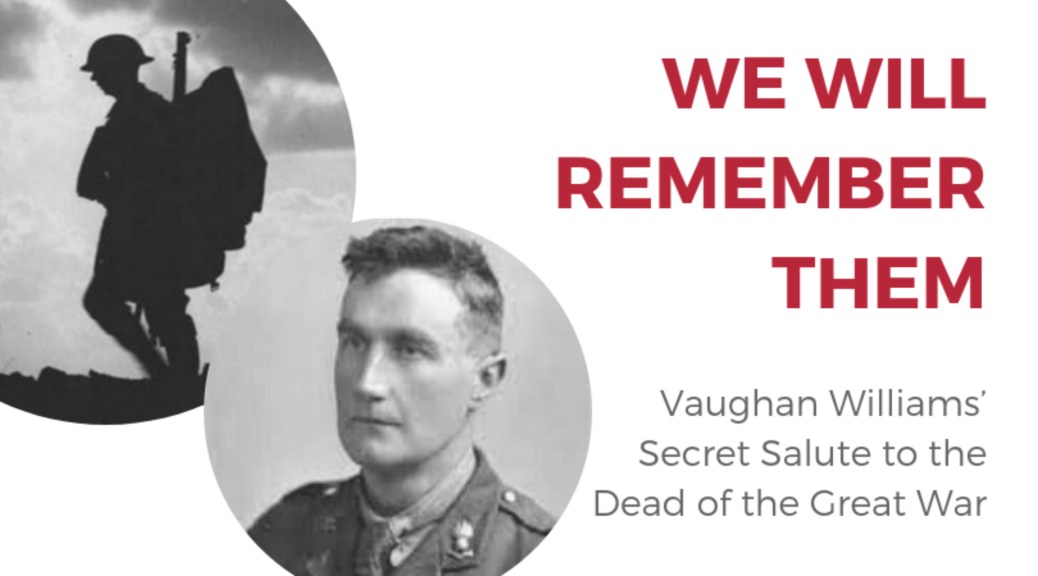
We Will Remember Them: Vaughan Williams’ Secret Salute to the Dead of the Great War

A talk by writer, historian and broadcaster Andrew Green.

Tuesday 20th November, 7.30pm in the Transept at St Mary’s Church, Redbourn

Free admission with light refreshments during the interval


Like so many who served on the Western Front, Vaughan Williams barely described his experiences – as an ambulance driver and then as a commissioned officer. We have to examine the music he wrote in the years after 1918 for clues.

Writer and broadcaster Andrew Green has researched the background to Vaughan Williams’s hauntingly beautiful yet barely-known short 1922 opera, The Shepherds of the Delectable Mountains. The text comes, of course, from John Bunyan’s legendary Pilgrim’s Progress. Andrew is convinced this opera is a carefully constructed memorial to those who died and an offering of consolation for the bereaved. In this talk, we’ll be taken back to those years after the Great War when the nation struggled to come to terms with an appalling catastrophe.

About Andrew Green

Andrew Green has been writing and broadcasting about music for over three decades. Before then he was an artiste manager in London, where his client list included Mitsuko Uchida, Julian Lloyd Webber and the Alban Berg Quartet. His broadcasting began in 1985 with a radio feature on contralto Clara Butt. Andrew has gone on to present and produce around 300 music programmes for BBC networks, including presenting In Tune and BBC Proms broadcasts on Radio 3, Music Review on the World Service and many documentaries for Radio 4.

As a journalist, Andrew has written for many UK newspapers and most leading musical journals, including Classical Music, Early Music Today and BBC Music – in the last case covering subjects as diverse as JFK and music, Vaughan Williams’ Great War, the history of harmoniums and music heard at the Battle of Waterloo. The life and music of Vaughan Williams has intrigued him since his teenage years.

Andrew is also a research fellow at the University of Hertfordshire, where he teaches and devises projects in the area of oral history – work featured in a recent BBC radio documentary, Instant History.

Click here to download a printable poster for the talk