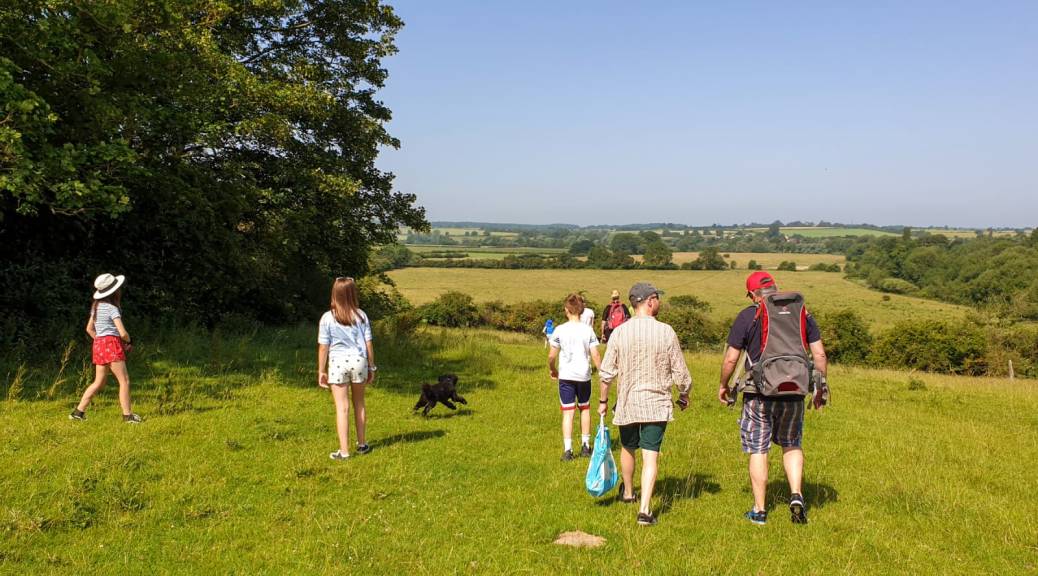
In the last weekend of June, 14 adults and 11 children spent the weekend at the Chellington Centre in North Bedfordshire. It was located in a beautiful part of the Bedfordshire countryside, overlooking the River Ouse.
The weekend included some families staying over (sleeping in bunks in the converted church, with a few camping in tents) and some visiting for the day. Blessed with wonderful weather, time to spend with each other, great food (and drink!), a fire pit, BBQ, table tennis and table football, and so much more, it was a wonderful way to spend a summer weekend.
Here is what some of those who came have to say about it
“For me this weekend gave the opportunity for all of us to share and see the beauty of God’s Earth. The location and weather all helped but it was the coming together of old and young enjoying, companionship and spirituality in a relaxed way. My abiding memory was observing parents, adults and children of all ages all working together to create their ideas of God’s Wonderful world in paint and craft, all chattering away and engrossed in putting their ideas down. We had such diverse ideas about what creation meant.”
“Doing the nature art was really fun because we could use all the things we collected by the lake. And my favourite bit was toasting marshmallows on the fire when it was really dark. If we want to look after the planet we have to collect everyone’s litter.”
“What I liked about our time at Chellington was the opportunity of a different way of being together.”
“I loved the relaxed and interactive nature of Saturday; the focus on God’s creation in the park and then the opportunity to create something in groups around what we had seen, heard, collected, stimulated conversations and fun. This mixed well with the times we ate together, and worshipped and thought about how we can help safeguard God’s beautiful world – at home, in our places of work, education, church – reducing the use of plastic, composting, recycling.”
I AM HOME!!! Official return time is 15.27 for those guessing. Thanks for the amazing support, interest, generosity and encouragement. I am very grateful to you all and very glad to be back in Redbourn, as always…
Yeovil. One to go..
Exeter, Exmouth etc. all begin with an E. There just isn’t a place in the whole country that begins with X. But this place does…
I’m officially shattered. Night, night. Thanks for all the messages, support and sponsorship. It’s been a long but fun day. (Just the three ‘easy’ ones to do tomorrow then…)
V – Lovely evening tour of God’s own county…
U – Sorry for the radio silence. Battery was almost gone.
Trent – Yippee!
Slightly unnecessary subtext given the fact I haven’t seen a car for nearly an hour!
Rimpton – a long hot walk to possibly the smallest place on my travels.
Q was always going to be slightly tricky but great lift from Danny all the way as he now heads to Padstow.
Popham. I didn’t promise that every lift would be in a car…
Old Basing – Well, that was a struggle…
Newbury
Marlow Bridge
Loudwater
Knotty Green
Night night…
Hedgerley – No, nor had I but it’s very pleasant. #8 and counting.
Gerards Cross
Farnham
Ealing – It is hot out and about.
Denham
Fantastic lift from Akhtar and Ayaz. Thank you so much.
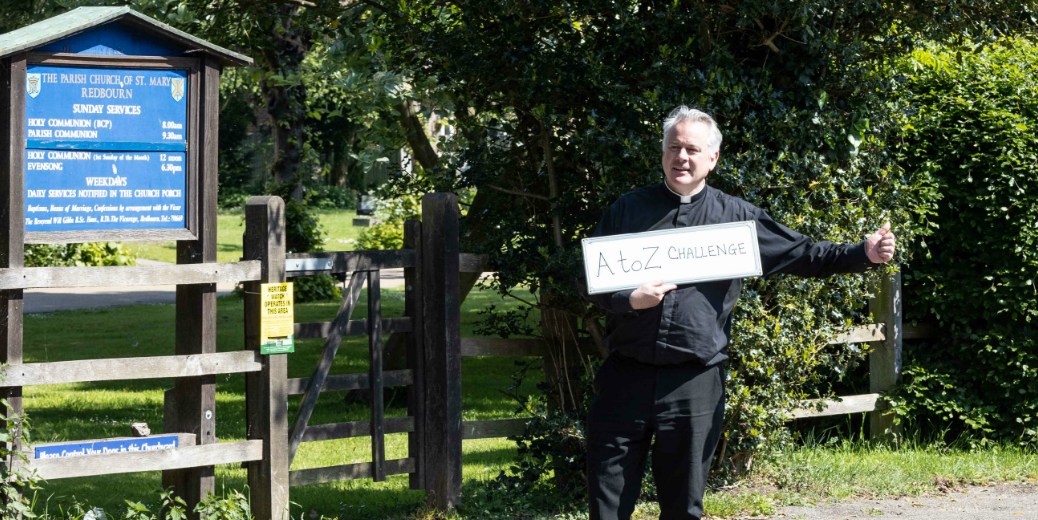
In further confirmation of a midlife crisis, Will is setting off on an extraordinary A to Z Challenge. Setting out from St Mary’s at 9am on Friday 12 July he will attempt to hitchhike around the country visiting 26 places each starting with the next letter of the alphabet.
With just a toothbrush and £10 in his back pocket, he will set off without a fixed plan or itinerary and relying on the kindness of strangers and just see where this adventure takes him. Will he end up in Zeebrugge or at the zoo? Only time will tell but it will be a big challenge and a lot of fun.
And more importantly he will be aiming to raise lots of money for Youth Talk in St Albans which is the St Mary’s Charity of the Year for 2019.
Youth Talk provides confidential counselling and support for local 13 to 25 year olds facing anxiety, grief, low confidence and other issues, and it’s a great cause to get behind at a time when being a teenager is increasingly complex and challenging.
Will is encouraging people to sponsor him in one of two ways. You can either sponsor him per place he gets to (hopefully all 26) or per mile he covers over the course of the weekend. You can sponsor him online via the link below, or there are sponsor forms in church as well.
And just for a bit of fun, we’re inviting people to guess how long the challenge will take. He’s aiming to get back, having covered all 26 places, by the end of Sunday 14 July. Will he manage all 26 places? Can he do it in a day? Two days? There’ll be a prize for the person who has the closest guess to the time he actually gets back to the church door.
This article by Damian Cranmer is the latest post in the Choral Evensong Blog, with insights into the background, history and composers of the music sung by the choir at our monthly Choral Evensong services.
William Byrd
The responses for our July Choral Evensong are those by Byrd, right up there with Smith as the best and most popular of all settings. It’s surprising how Byrd cleverly hides the traditional plainsong melody in the tenor part. We sing Psalm 65, ‘Thou O God art praised in Sion’. The first part mixes praise (‘who stillest the raging of the sea’) with penitence (‘my misdeeds prevail against me’), and the second part has the familiar harvest words beginning ‘Thou visitest the earth’. The chant is by George Garrett, who was organist for many years at St John’s College, Cambridge. At the end of the 19th century his settings of the canticles were among the most popular, but he is now largely unknown. If you remember from the 60s the spoof weather forecast sung to Anglican chant by the Master Singers, it was another of Garrett’s chants which began the recording, still available on YouTube.
Herbert Brewer
The canticles are by Herbert Brewer, his setting in E flat. Wikipedia claims that Brewer (1865-1928) “lived in Gloucester his whole life” but that seems a little wide of the mark. He grew up in Gloucester and was organist at the cathedral for over 30 years from 1896, but held posts in Oxford, Bristol, Coventry and Tonbridge in the intervening years. His work in Gloucester involved much activity outside the cathedral, particularly in relation to the Three Choirs Festival, which he conducted on eight occasions, and for which he wrote several major works on both serious and light-hearted subjects. Of his compositions, Grove’s Dictionary (4th edition 1940, and unchanged in today’s online version) stated that “he seemed happier in the concerts of the Shire Hall than in the cathedral.” Sadly, in light of this, he is known today mostly for his settings of Magnificat and Nunc Dimittis which remain in the repertoire of cathedrals and which St Mary’s choir have sung on a number of occasions. The thematic material of his E flat Magnificat from 1904 is positive, confident and largely upward in its movement, as heard in the organ introduction, which is repeated at the beginning of the Gloria. The Nunc Dimittis is stately and has its own Gloria.
Herbert Howells
The anthem is ‘Like as the hart desireth the waterbrooks’ by Herbert Howells, a setting of the first three verses of Psalm 42. I have to say that this is a piece I have never liked. When I say never, I mean from the time I first sang it as a boy treble. I could try to analyse why, but actually a more interesting question arises, first posed to me as an undergraduate: which is the greater experience in music, performing or listening? In those days I had no hesitation in replying, performing. But it is extraordinarily fortunate that there are many more listeners than performers. It’s not quite fair (but it’s interesting!) to ask how many great performers are found in the audience at the concerts of others. So, while I may not have been right, I also may not have been quite so wrong as my later self sometimes feared.
For whom did Howells write the piece? The simple answer is for Thomas Armstrong, who at the time of composition (1941), was Organist at Christ Church, Oxford, one of the few cathedrals not to receive a dedicated Mag and Nunc from Howells. In fact, at Christ Church, they have often referred to what we all know as the New College Service as “the Oxford Service”, not to give too much credit to neighbours! But another answer might be that ‘Like as the hart’ was written for the benefit of the congregation and for the glory of God. I must listen to it a few more times! This performer/listener debate was at the heart of the “Choral Revival” in the middle of the 19th century. One side argued for congregations to be passive in seeking for inspiration in beautiful music; the other for familiar, simple and often plainsong melody to be available for all to sing. Cathedral Choral Evensong is derived from the former; the plainsong mass of Merbecke, which was pretty universal until about 50 years ago, is an example of the latter argument.
Howells (1892-1983) had lessons with Herbert Brewer at Gloucester Cathedral before gaining a scholarship to the Royal College of Music, where his tutors were Stanford, Charles Wood and Parry, all composers, like Howells, whose aspirations were to compose in a wide variety of genres, but whose reputation now relies almost exclusively on their church music. I was surprised to find that Howells, for whom the organ is an intrinsic part of his compositions, never held an organist’s post, other than as deputy for Robin Orr at St John’s, Cambridge, during the war years. ‘Like as the hart’ is in three sections; a long opening statement from the tenors and basses with full choir joining at the end (verses 1 and 2), a central section begun by the sopranos with extensive repetitions of “my tears have been my meat day and night”, words that may have had particular significance for Howells whose son had died from polio in 1935, and a reprise of the opening section with an added descant-like line above the original. The tonality of the piece is E minor with much colouring from the flat 5th (B flat), and it seems that it somewhat reluctantly approaches the final major chord of E.
Samuel Sebastian Wesley
The voluntary is Choral Song by SS Wesley. Samuel Sebastian Wesley (1810-1876). named after his father and his father’s admiration for JS Bach, was, by all accounts, a difficult man. He rarely stayed long in an organist’s job because his musical views did not fit with the ecclesiastical hierarchy. But with hindsight we might have some sympathy with him because, in his composition, he was an important link between Purcell and Stanford. Choral Song, the third of Three Pieces for Chamber Organ of 1842, is aptly described by its title. It has a theme that is hymn-like in both melody and structure, and its festive nature has made it very popular; it is in rondo form and has been through a number of adaptations, which make it eminently suitable for almost any organ.







 St Mary's Church, Redbourn