

The psalm appointed for this evening is Ps 45, which begins ‘My heart is inditing of a good matter.’ These words have been set by Purcell, and also by Handel as one of the four anthems he wrote for the coronation of George II in 1727. (The most famous is, of course, Zadok the priest.) Verse 10 of this psalm has the memorable words, also set by Handel, ‘Kings’ daughters were among thy honourable women: upon thy right hand did stand the queen in a vesture of gold.’
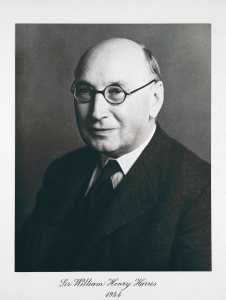 The Magnificat and Nunc Dimittis will be sung to Harris in A minor. This is a companion piece to Harris in A which we sang last year. The copies we use are from the St Albans Diocesan Choir Festival of 1964. Both settings are in the “short service” idiom; they contain limited word repetition and little counterpoint, which does make them short, but makes the words come through the texture clearly. Harris cleverly achieves musical unity by adapting the opening phrases to new words as the music progresses. The time-signature is a simple 4/4, but Harris follows the metre of the words and we have bars of six and, more occasionally, five and seven beats.
The anthem is ‘Surgens Jesus’ by Peter Philips (c1560-1628), an English composer who because of retaining his catholic faith fled to Holland. One source that I saw gave the text as that of Responsary 8 for Low Sunday in the Roman rite. There is an equivalence in the Anglican rite with the Gospel for Low Sunday, St John chapter 20 vv 19-20. “[Then] came Jesus and stood in the midst [of the disciples] and saith unto them, Peace be unto you…[alleluia]. Then were the disciples glad when they saw the Lord. [alleluia]” Philips was especially fond of setting responsary texts because the responds, in this case the alleluias, enabled him to repeat earlier music and make a satisfying musical shape – A (text) – B (alleluia) – C (different text)- B (same alleluia). In ‘Surgens Jesus’ the two text sections are set very differently. The first is in typical renaissance imitative style with word painting (rising five-note pattern for surgens); the words of Jesus, pax vobis, are set in very slow chords. The second text section, gavisi sunt, is largely chordal in quicker triple time.
 The voluntary is Altro recercar by Girolamo Frescobaldi (1583-1643). Frescobaldi was one of the greatest keyboard composers of the early seventeenth century and perhaps the first to be known mainly for his keyboard works. Altro recercar comes from Frescobaldi’s last newly composed publication, the fiori musicali published in Venice in 1635. The pieces in this publication are written for liturgical use in the mass, but use the standard keyboard forms of the day: toccata, canzona, capriccio and ricercar. By Frescobaldi’s time the ricercar had become a highly imitative piece and is in many ways the ancestor of the fugue. The altro recercar introduces three different themes which are combined in the final section.
Easter Evensong 2018
And now a full-time report on music listings at English Cathedrals at Evensong on Easter Day. The question was whether Stanford continued to hold sway for settings of the canticles at celebratory evensongs. Well, he does: 13 of the 44 cathedrals used his Magnificat and Nunc Dimittis settings and his nearest rival was Herbert Howells with 9. Between them they accounted for half the settings sung on this day. George Dyson (6), Charles Wood (5) and William Walton (2) were the only others with more than one listing. On individual settings Stanford also was predominant. His setting in A was listed 10 times, ahead of Dyson in D (6), and the Collegium Regale settings by Howells and Wood in F (3 each). If “Coll Reg” these days is inextricably linked with Howells, it should be noted that the Wood setting dedicated to King’s College, Cambridge is 40 years earlier and, judging from this Easter Day, has not been overtaken by Howells.
The survey has identified 20 canticle settings by 13 composers. 17 of these pieces were written by 10 of the composers in the hundred years from 1875 and Henry Smart’s setting can be only 25 years or so earlier. It seems that a powerful setting with independent organ part is what is wanted. The other two settings come from the years after the Restoration by Michael Wise and Henry Purcell. So nothing from the Renaissance and nothing from the last 40 years; and only three composers born in the 20th century, William Walton, Kenneth Leighton and William Mathias.
The anthems show a more varied range. There are works by Byrd, Gibbons and Weelkes of early composers and more recent compositions by Jonathan Dove, Richard Shephard and Matthew Owens, as well as traditional favourites. Six cathedrals programmed Wesley’s “Blessed be the God and Father”, four “Worthy is the Lamb” from Messiah, and three Byrd’s “Haec dies”. This is much as you would expect, but it is not entirely fair because other anthems were sung at morning services.
Neither is it quite fair to talk about Matins because of the accent on communion services on Easter morning, but I’m going to. Only 13 of the 44 cathedrals had a choral Matins on Easter Day and seven of them sang a Stanford Te Deum (5 Bbs and 2 Cs). Walton’s Jubilate came up three times, Britten twice (what a shame he didn’t write a Mag and Nunc), and Ireland and Vaughan Williams also twice. We went to St Peter’s where they did Stanford in B flat and jolly good it was too! So Stanford’s position is confirmed: he is the go-to composer for celebratory canticles.
So what is my reaction to this? I’m not at all surprised by the dominance of Stanford and Howells, but it is interesting that Dyson in D holds its place so well and I’m delighted that Wood continues to feature. But where are the new pieces? Is the divide between concert and church music becoming wider? And if it is, are congregations more conservative than audiences? It all comes down to the place of music in worship, but it’s important that the best composers are encouraged to write for the church.
Anyone who is not completely turned off by the “anorak” nature of all this can get a list of the full result from me.
Damian Cranmer


 Music plays a significant part in this service. ‘Ride on’ by Grayston Ives (b1948) was commissioned for the Ash Wednesday to Easter for Choirs volume (1998) in the comprehensive OUP series of albums of choral music for all seasons. Away from composing he is Bill Ives, former tenor in the King’s Singers and more recently director of the choir at Magdalen College, Oxford (actually Informator Choristarum). In this post he was responsible for the 2003 recording of the music of Orlando Gibbons (With a Merrie Noyse) which was one of the earliest recordings of Tudor music to explore the use of lower pitch and a choir with high tenors instead of altos. (See last month’s blog.) The words are those of the hymn (HON 435) by Henry Hart Milman (1791-1868), an interesting character whose biography on Wikipedia is well worth reading. The music follows the upbeat nature of the words with prominent use of a rising 5th until “in lowly pomp ride on to die” where all becomes much softer and the choir sings on one note to the end. The organ is independent of the choir throughout and is dominated by the rhythm – crotchet, dotted minim – perhaps illustrating the inevitability of what is to come.
 St Mary's Church, Redbourn