
Once upon a time, there were two brothers. Their father had a large farm and when he became too old to work, he called his sons to him. “I am too old to work anymore,” he said. “I will divide my farm in half and give each of you one half. I know that you will always work together and will be good friends.”
When the brothers first started farming on their adjoining farms, they were the best of friends and would share everything together. Then, one day there was an argument between the two brothers and they stopped speaking to one another. For many years, not a word was spoken between them.
One day, one of the brothers was at his house when a carpenter came to his door and said, “I would like to do some work. Do you have any work that I can do?” The brother thought for a moment and then replied, “I would like for you to build a fence on my property. Build it down near the stream there that separates my farm from my brother’s. I don’t want to see my brother anymore and I would like you to build a high fence there please. I’m going into town and I’ll be back this evening.
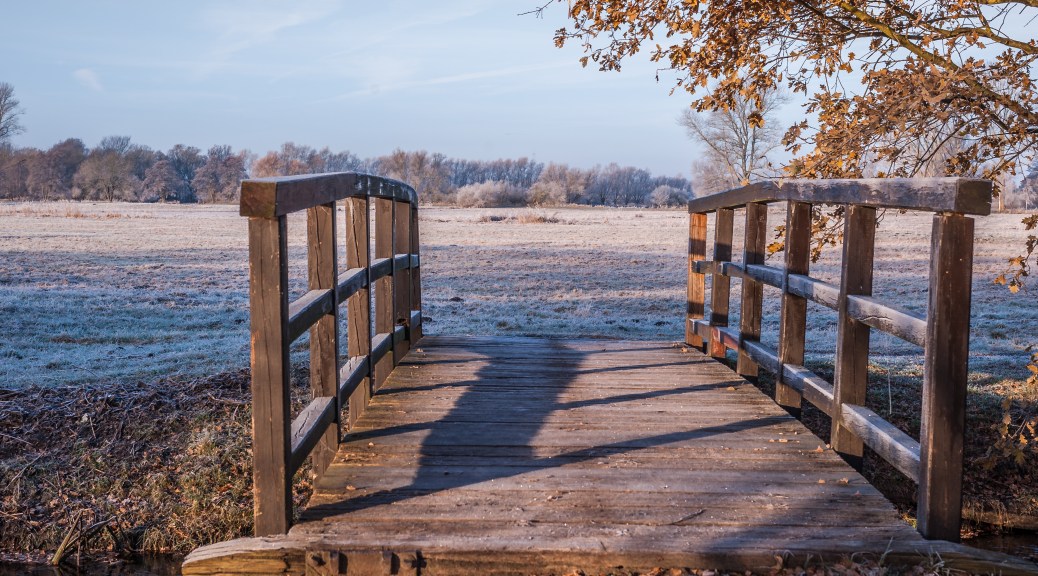
When he came back that evening, he was shocked to see that the carpenter had not followed his instructions. Instead of building a high fence there, he had built a bridge over the stream. The man walked down to take a look at the bridge, and as he did so, his brother walked toward him from the other side. His brother said, “After all the terrible things I’ve done to you over the years, I can’t believe that you would build a bridge and welcome me back.” He reached out to his brother and gave him a big hug.
The brother then walked back up to his farmhouse to talk to the carpenter. “Can you stay?” he asked. “I have more work for you to do.” The carpenter answered, “I’m sorry but I can’t stay. I have to go, for I have many other bridges to build.”
Author unknown
Sometimes we have disagreements with members of our family or amongst friends. It started small but nobody is willing to back down or make the first move and now we’re stuck with division, suspicion and bad feeling. Sometimes we fall out with a neighbour and we stop talking and just mutter and chunter instead. Sometimes we even fall out with God, blaming Him for what is happening in our lives and we fall away from church.
Lent, which begins on 1 March, is a great time to ‘build some bridges’, to heal those divisions that eat away at us, and to join ourselves with the reconciliation, hope and love that we find in Jesus. As this parable reminds us, it is never too late…
Will


 For the responses we continue to explore settings written in the last century with those by Philip Radcliffe (1905-1986), who went to King’s College, Cambridge as an undergraduate, was appointed a Fellow in 1931 and pretty well never left. He was primarily a teacher and critic but was an enthusiastic composer, whose style was described in The Times obituary as ‘Vaughan-Brahms’. His responses were written between Good Friday and Easter Day in 1972 for Edington – flash of inspiration, last minute activity or well in advance of commission for annual August Festival? They include a full Gloria and a setting of the Lord’s Prayer.
 The anthem is to be Whitlock’s “Be still, my soul”. Percy Whitlock (1903-1946) held organist posts in Rochester and Bournemouth, where he was also municipal organist at the Pavilion: we heard his rousing Paean in October. This anthem is much more restrained. It was published in 1930, suggesting that it comes from his Rochester period. The three verses proceed with organ interludes and a setting of the words which makes for easy understanding. These words are not those of HON 54 (Be still, my soul: the Lord is on your side) which we sing to Sibelius’s memorable theme from Finlandia, but are a poem by WD Maclagan (Be still, my soul, for God is near; the great high priest is with thee now). William Dalrymple Maclagan (1826-1910) was archbishop of York from 1891 to 1908, and as such crowned Queen Alexandra at the 1902 coronation.
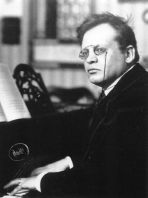 Whenever Jonathan Goodchild thinks of Reger, he is reminded of the story of a notice said to have appeared in the Abbey during the organ festival which read “Please God, no more Reger”; nevertheless he’s giving us some! Max Reger (1873-1916) was a gifted pianist and organist who composed a huge amount of music in a relatively short time. His style fuses the chromaticism of the late nineteenth century with the German tradition of Beethoven and Brahms, and particularly the counterpoint of JS Bach. The voluntary for this choral evensong is the Passacaglia in D minor and a fine piece it is to end the service. It would be easy to get worked up about the difference between passacaglia, ground bass and chaconne. They all use recurring patterns, but a chaconne is composed on a repeating chord sequence, while the other two are thematic. The greatest of all ground bass composers, Henry Purcell, wrote a melody over the bass which drew the attention away from the bass; Dido’s Lament is a fine example. With passacaglia, you’re supposed to follow the line throughout. Reger’s Passacaglia is modelled very closely on Bach’s great work in C minor: it has the same rhythmic pattern, the same length of phrase, and the same overall shape. We hear the theme first on the pedals, and it remains there for the following 12 variations, in which the excitement is gradually built up by quicker note values in the upper parts, more complex harmony and, of course, a controlled crescendo. In the last variation, the music moves into the major key.
 St Mary's Church, Redbourn