

This month I’ll start at the end – with the voluntary. What is a voluntary and for whom is it voluntary? The Shorter Oxford English Dictionary (that’s the one in only two volumes of over 3500 pages each) gives a meaning up to the Reformation of “music added to a piece at the will of the performer”, leading to “an organ solo played before, during, or after a church service….” from the early 18th century. 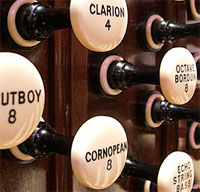 The playing of such a piece, particularly at the end of a service, is voluntary for an organist only to a certain extent – it is expected. For everyone else it is entirely voluntary, clergy and choir who depart to their vestries, and congregation who sit and listen, depart, greet friends and tidy the church. And what about applause? There were times when applause would never have been considered appropriate in church, but we now applaud brides and grooms and newly baptised babies. So although we don’t (yet) applaud sermons and anthems, let’s not deny the organist appreciation for his or her playing. What about an occasional “compulsory”?
On this occasion, Jonathan plays JS Bach’s Chorale Prelude BWV651, the Fantasia on “Komm, heiliger Geist, Herre Gott” (Come, Holy Ghost, Lord God). The words of the German chorale are by Luther based on the Latin hymn “Veni, sancte spiritus”, so most appropriate for Whit Sunday, as is the anthem (see below): the tune is by Johann Walter, and Bach puts this in long notes for the feet, while the hands weave a fantasia above. If fantasia suggests random improvisation, then this is not what you get from Bach, at least on the page. Everything is carefully ordered and the semiquaver arpeggios with which the piece begins are rarely absent and, at times, treated with the precision of a fugue. The genius of Bach is to make this calculated structure sound improvisatory. Do stay and listen.
The responses are our own home-grown version of those by Richard Ayleward, now for five voice parts. The increase from four to five makes more difference than you might expect, and I am a fan of the richer texture. So, I believe, was Orlando Gibbons, and it’s one of his pieces, known only to us for four voices, but which obviously needs a fifth voice, that gives proof that some early music was reduced to fit what became the choral norm of soprano – alto – tenor – bass. Richard Ayleward (1626-1669) is a couple of generations after Gibbons, so not that “early”, but he certainly relished large scale performances. His short career took off at the Restoration with his appointment as organist of Norwich Cathedral. He must have been active during the Commonwealth because he wrote music for the Coronation of Charles II.
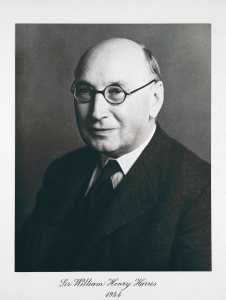 Our Magnificat and Nunc Dimittis is the setting in A by Sir William H Harris (1883-1973). Harris was a fine organist from an early age and held appointments in Lichfield and Oxford (New College and then Christ Church) before moving in 1933 to St George’s Windsor where he remained for 28 years. His most famous, and probably best, piece of church music is the anthem “Faire is the heaven”. The canticles in A are constructed from a few simple phrases which are adapted as necessary to new words: the openings of the Magnificat and Nunc Dimittis illustrate this well. In addition the two Glorias reprise the opening of their respective movements, producing a satisfying structure. In the baroque period, composers (with tongue in cheek?) made the reprise at “as it was in the beginning” (sicut erat in principio). In fact this feature was the major factor in reuniting Handel’s psalm Nisi Dominus with its Gloria from which it had become separated for well over 100 years. We sing the Harris from music contained in a booklet for the Diocesan Choirs Festival held in St Albans Abbey in 1966. There are similar booklets for 1964 in the choir library (containing Harris’ setting in A minor), which suggests that St Mary’s choir took part in these events. Anyone remember?
The anthem is Peter Philips’ “Loquebantur variis linguis”, in Catholic usage the Responsory after the second lesson at Matins of the Feast of Pentecost. The text is based on The Acts of the Apostles (ch2 v4) and can be translated “The Apostles were speaking in different languages of the great works of God as the Holy Spirit gave them utterance. Alleluia”. It’s not easy to put Philips’ life into one sentence, but here goes. A lifelong catholic who had been a chorister at St Paul’s, possibly taught by Byrd, Philips (c1561-1626) fled Reformed England in 1582 for Rome before settling in Antwerp, where he not only lost his new wife in childbirth and their daughter seven years later, causing financial disputes with his late wife’s family, but also spent time in prison having been accused (unfairly, as it turned out) of plotting against the English Queen, and eventually in 1609 became a priest, all the while composing copiously. This work is very much in the style of Palestrina, easy flowing imitative counterpoint for the main text with a more energetic and rhythmically complex “alleluia”.
Damian Cranmer
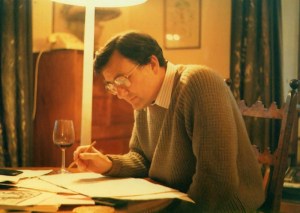 I wrote about John Sanders last month in connection with ‘The Reproaches’. We’ll sing his responses on this occasion. They were written in 1983 to mark the centenary of the death of Richard Wagner. There is much use of the Dresden Amen with its characteristic motive of a rising scale, extensively used by Wagner in his opera Parsifal. This gives the music a very positive feel. I can’t remember whether Parsifal is a particularly positive opera – a bit of a marathon to find out!
 The anthem by Charles Villiers Stanford (1852-1924) is ‘Why seek ye the living among the dead’, a setting of words from the Gospel of St Luke, Chapter 24 verses 5-7. These are the words of the “two men .. in shining garments” who appeared to the women who first discovered the stone rolled away from Christ’s tomb, so highly relevant to this time of Easter. Stanford composed this work in about 1890, three years after he had been appointed Professor of Music at the University of Cambridge in addition to his post as Organist of Trinity College. This might have been quite enough for most people, but Stanford had been invited by George Grove (of music dictionary fame) to become involved with the Royal College of Music from its opening in 1883 as composition tutor and orchestral director. It could be said that among his lesser known achievements was as teacher of many of the leading composers of the first half of the twentieth century, including Frank Bridge, Herbert Howells, John Ireland and Vaughan Williams. However, in attempting to get them to follow in his own Brahmsian tradition, Stanford seems to have ensured that they developed their own voice – success indeed. And then, of course, there was his own composition and conducting. Stanford’s compositions were not limited to the church music on which his reputation is mostly based today. A view that all is not necessarily lost for his other work can be found in The New Grove: “his two last and arguably best operas, The Critic (1916) and The Travelling Companion (1919), had still not attracted the attention of professional opera companies by the mid-1990s.”
 The other short piece is Ecce quomodo moritur justus by Jacob Handl (1550-1591), who was born in Slovenia and worked in Austria and Bohemia. Handl is almost certainly a German translation of his original name, it being a regular occurrence for composers who moved around to have their names transformed or translated. One thinks of Lassus (di Lasso) and Victoria (Vittoria), but also of the English composer who went to Italy as John Cooper and came back as Giovanni Coperario. (Q: who, if he had settled in England, might have been known as Claud Greenhill?) Handl was prolific and Ecce quomodo comes from his Opus musicum, a collection of 374 works in 4 to 24 parts. Compared with the contrapuntal Morley, where each part sings a version of the same melody in imitation, the Handl is chordal throughout, using harmony as its main expressive feature. The text is the 6th Responsary for Holy Saturday and is derived from Isaiah 57:1; “Behold how the just man dies, and nobody takes it to heart.” In the second part, words from Psalm 76 v2 are followed by a repeat of the ending of the first part.
 The anthem is “O sons and daughters let us sing” by Henry Walford Davies (1869-1941). Walford Davies studied at the Royal College of Music with both Stanford and Parry and was organist at the Temple Church for 21 years. This anthem is a good example of a style of composition prevalent in the early twentieth century, in which a traditional hymn tune is elaborated with new harmonies, descants and varied textures. Neither this tune, the French 17th century melody known as ‘O filii et filiae’, nor the words have made it into Hymns Old and New, but both are comparatively well known.
 And so to Stainer (1840-1901). Poor old John Stainer! His reputation for almost the whole of the last century was as representative of all that was worst about Victorian sentimentality. It was fashionable to regard him as persona non grata, and I enthusiastically joined the fashion, based mostly on the idea that it was the right thing to do, allied to a very incomplete knowledge of his oratorio,The Crucifixion. The first chink in my armour was when I discovered that a chant I had admired for many years since hearing it on the BBC’s Choral Evensong was actually one of Stainer’s. And then, last summer, came this Magnificat and Nunc Dimittis in B flat. The work dates from 1884, well into Stainer’s time at St Paul’s, where he was instrumental in improving the standards of the music and widening the repertoire. He is later said to have regretted publishing his compositions as he knew they were “rubbish”, which perhaps gave the opportunity to those critics who were inclined to downgrade his reputation. Interestingly, Stanford, who was 12 years younger than Stainer, had already written his B flat service in 1879. Of the two, Stanford was more the composer and Stainer more the educator and church musician, but looking at the two services it does seem odd that Stanford’s is one of the most widely performed of all settings of the evening canticles, while Stainer’s is almost completely forgotten. It may be that the Stainer is less interesting rhythmically, more four-square and using traditional patterns – the shape of the phrases in many Magnificats is sufficiently similar for them to be identifiable without the words. So why should you come to hear it? Because it’s rare, and you might, like me, undergo some sort of conversion! The harmony is adventurous, juxtaposing the keys of D and B flat, and, in fact, the Magnificat begins in D in the organ before moving to the home key for the first choral entry. The fugue in the Magnificat Gloria has to be heard to be believed: entry after entry of “as it was, it was in the beginning” is piled up until the sopranos can resist no longer and come in on a top B flat! Satisfyingly, the Amen recalls the opening of the movement now in the home key of B flat.
 St Mary's Church, Redbourn