All posts by KFord

Choral Evensong Blog: Sunday 3rd June, 6.30pm

Richard Shephard

The responses are by Richard Shephard, a contemporary musician, not to be confused with Richard Sheppard, a composer of pre-Reformation Latin music in the first half of the sixteenth century. Shephard spent his early adult life in Salisbury undertaking several activities including as a lay clerk in the cathedral choir of Richard Seal, and it is to Seal and his choir that these responses are dedicated. They were published in 1985, the year that Shephard moved to York to take up the post of headmaster of the Minster School: a parting gift, perhaps?

The responses are interesting for a number of reasons. The intonations of the cantor are newly composed, the Lord’s Prayer is set for the choir, and the texture, while nominally in four parts (SATB) has many points where the voices divide, giving the music a varied and at times rich colour.

Thomas Attwood Walmisley

The canticles will be Walmisley in D minor. Thomas Attwood Walmisley (1814-1856) was the godson of the composer Thomas Attwood, with whom he had early composition lessons. At the age of 16, Walmisley was appointed organist of Croydon Parish Church, and three years later as organist jointly of Trinity and St John’s Colleges, Cambridge. At the age of 22, he proceeded to the post of Professor of Music at the university. This may have been as much a reflection of the sorry state of music in the university as of his undoubted prowess as a musician. It is greatly to his credit that he raised the status of the post he held and also the quality of his joint college choir, which was described in one instance as the best in England.

He suffered from bouts of depression from which he consoled himself with wine, both of which may have been the cause of his untimely death. The D minor Magnificat and Nunc Dimittis date from late in his life and are said to have been rescued by a colleague from the waste paper basket, a most fortunate occurrence as they remain his most popular composition and are widely sung today. My copy of this music is in a booklet produced by the RSCM to be performed at evensong around the country for the Festival of Britain in 1951. Walmisley is there alongside Tye, Weelkes, Purcell, SS Wesley and Stanford as part of the RSCM’s “endeavour to see that the music represents the best of all periods of the English school of composition” – more contemporary works were to be included in the service at the Royal Albert Hall.

The Magnificat is interesting because it alternates strong unison passages with more gentle music for upper voices. It can be used as an opportunity to involve the congregation in singing the canticles. There’s one other thing to note about the piece: the last verse of the Magnificat, ‘He remembering his mercy’, is repeated, so those waiting for ‘and his seed for ever’ to stand for the Gloria should not get up until they hear it for a second time!
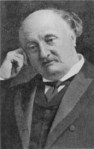
John Stainer

The anthem is I am Alpha and Omega by John Stainer, a work of which I had no prior knowledge, though there are several versions on YouTube, which suggests that it is not unknown elsewhere. The words, designated for Trinity-tide, are from Revelation Chapter 1 Verse 8, followed by the Sanctus, and the music is in two equivalent parts, each introduced by a solo voice. The copies from our choir library are well used and originated from St Ann’s Church Newcastle-on-Tyne. It would be interesting to know when it was last sung in Redbourn (are there any records of music sung in church records?). If these well travelled copies are the result of someone finding it impossible to throw music away, as I do, it is very welcome. It is impossible to be certain of future tastes, and I have written about the reassessment of Stainer before now. Walmisley told an unbelieving audience in Cambridge that JS Bach would come to be recognised as unparalleled as a composer!

The voluntary is the first movement of JS Bach’s Sonata in C BWV529. This is the fifth of a set of six pieces often known as trio sonatas because they use the texture of the instrumental works by composers such as Corelli, often two violins and continuo. On the organ the two hands play on different manuals partly to get matching but different sounds, but also to keep out of each other’s way – the right hand is sometimes lower than the left. Meanwhile the feet provide a harmonic bass. So there are three independent melodic lines and, although you are playing only three notes at any one time, the interaction of their independence produces a challenge as great for the brain as the fingers!

Damian Cranmer
St Mary’s Holiday Club 2018: Guardians of Ancora

The Guardians of Ancora are back, and they really need your help! Are you ready to find the treasure and protect the stories about Jesus that will make the Spire of Light shine brightly once more?

The 2018 St Mary’s Church Holiday Club runs from Monday 23rd July to Friday 27th July, with a launch service on Sunday 22nd July.


Age:  For children going into Year 1 to those leaving Year 6Children going into Year 8 and above can come and help but must attend special training.

Costs

  • Going into Year 1 and Year 2 – £40
  • Going into Year 3 to leaving Year 6 – £45
  • Early Bird offer for whole week – Years 1-2 = £30,  Years 3-6 = £35

Timings:

  • Years 1-2 – Mon – Fri – 9.30am – 1.00pm
  • Years 3-6 – Mon – Thurs – 9.30am – 3.00pm,  Fri – 9.30am – 1.00pm

Children need a packed lunch each day, except Friday, and sensible footwear and clothes suitable for the weather.


How to book:

Application forms are currently available inside church, (on the table on the right as you go in the main door).

Please e-mail Ailsa with any questions.

Sermon: The Good Shepherd

Owing to the difficulties experienced with the sound system on two consecutive Sundays, Tim and Paul have asked for my sermon of April 22nd to be put here on the website. The PA system is currently being investigated so we hope for better things in future!  Lois Smith

John 10: 11-18

This is probably a fanciful thought but the name ‘Windrush’ makes me think of the Holy Spirit – that rushing, mighty wind that came down at Pentecost and fell on people from many nations, enabling them to speak in their own languages but be understood by all.

Those who came over on the Windrush came to a post-war Britain, victorious in one way but also feeing impoverished and defeated by the mammoth task they faced to rebuild our shattered country. I remember as a child of about 6 seeing pictures of large parts of our cities that looked like Syria looks today.

As we know, the people on the Windrush were invited to come and help save the Mother Country. No doubt they came with mixed motives – wanting to help but also wanting better lives for themselves and their families. They came, they worked hard, they rebuilt: they contributed in many different ways and they settled. Why at this late stage have they and their now adult children been threatened with being thrown out of the nation’s sheepfold? It is as if the Government, and, in particular, the Home Office, have been more concerned with money and their new and over-harsh immigration policy than with the fate of individual sheep. It is encouraging that the wrongs are now being slowly righted, but it comes way too late for some who have lost their jobs, been denied health care and suffered huge emotional trauma through being given a taste of the ‘hostile environment’. The stories are heart breaking and they keep coming.

What a contrast with Muslim Turkey who have built a vast refugee camp near the border with Syria, where Syrians in their thousands are living safely with basic amenities and money provided weekly for their subsistence – some of this provided by Europe but certainly not all. As David Lammy, a black M.P. , thundered in the House of Commons: “ We are shamed as a nation by our treatment of the Windrush Generation”.

So what has this to do with sheep and shepherds? Perhaps the parable that we heard in our Gospel does not immediately register with those who live in 21st century cities; but the message it contains is as relevant and vibrant as ever. I think it contains three questions: what are the characteristics of the Shepherd? What is the nature of the sheepfold? And who can and cannot be included?

Jesus’ metaphor is not a new one. The whole of chapter 34 in the Book of the prophet Ezekiel is about the rulers of the Israel of his day, who are behaving like the hirelings in Jesus’ parable, and the Sovereign Lord who takes over as the shepherd of his people. “I will look for those that are lost, bring back those who wander off, bandage those who are hurt, and heal those who are sick”. It is well worth reading that chapter.

In the parable Jesus calls himself the Good Shepherd. In translating from the Aramaic the Greek word ‘agathos’ could have been used for ’good’ – meaning morally upright; but instead the word ‘kalos’ was chosen – meaning not only moral but beautiful: someone who is not just ordered and efficient but also winsome and attractive, whose kindness and graciousness draws people to him. In the passage before our Gospel reading Jesus refers to Himself not as the shepherd but as the door or gate of the sheepfold. This is a reference to the Palestinian shepherd’s practice of lying at night across the open entrance to the sheepfold so that their bodies offered protection to the sheep from lions, bears, wolves and robbers. Many were badly injured and some fell to their deaths among the sheep – in contrast to the hired hands who ran away.

So what is Jesus showing us of the qualities of the good shepherd? Faithfulness for one; then strength: they fought hard with only clubs as weapons; then compassion and knowledge of each one of their sheep as individuals. Palestinian shepherds didn’t have sheepdogs – they called each sheep by name and the sheep followed them.

A group in the parish have been reading a little book by Rowan Williams called ‘Being Disciples’. He makes a great deal of the importance of our names to God. Rowan Williams says this: “I know that I exist, I live, I flourish simply because of God’s speaking”. ‘I have called you by name, says God, you are mine’ (a quote from Isaiah). And on that divine speaking of our name rests our whole being.”

And so to the second question: “What is the nature of the sheepfold – be it Church or Nation?” Here the metaphor in the parable to some extent breaks down. Being a Christian within the Christian Church is not, or should not be, a safe haven with the shepherd offering us physical protection. Two days ago we had a phone call from someone who used to be one of Robin’s curates during our days in Chesham. He said that he had taken early retirement in order to care for his wifewho has apparently had MS for the past 4 years and is now in a wheelchair. We remembered her as a very active primary school teacher and mother of 3. He sounded lost and grieving and I gained the impression of a life as a huge struggle where endurance was the quality they both most needed.

Jesus never suggested that life for his followers would be pleasant and straightforward. We are asked if we can drink the cup that He will drink, and also told that He came’ not to bring peace but a sword’. The safety and security of the sheepfold refers not to physical protection from the trials of life which beset us as human beings and as Christians, but to the security of a life lived in relationship with Him. “I know my own and my sheep know me, just as the father knows me and I know the Father”. What we are offered is not an easy and comfortable life in the sheepfold but a life which is likely to include pain and risk as we seek to negotiate our way through a secular society where values and attitudes are increasingly widely different from the way of Jesus. Salvation lies not in the security of the sheepfold but often more through our own personal version of life on the Cross.

Recently we have been watching Andrew Marr’s ‘History of the World’. A story in one of the episodes was of two of the earliest Christian martyrs – Perpetua and Felicity. Perpetua was a young married noblewoman of 22 who became a Christian along with her slave girl, Felicity, in their home city of Carthage. Perpetua was brought before the Roman Authorities and told that if she did not renounce her Christian faith she would be executed. This she refused to do and she and Felicity were thrown into a filthy and overcrowded prison where she gave birth to her baby son. Her father begged her to renounce her faith and save herself, but she handed the baby to her mother and brother when they visited and then went to her death with Felicity in the arena at Carthage. There is an eyewitness account of their deaths along with two or three other Christians. They were beaten by gladiators and mauled by wild beasts but the huge baying crowd fell totally silent when the young women were put to the sword. Apparently Perpetua guided the sword of the young and inexperienced gladiator to her throat – to make sure of her death. Today Perpetua and Felicity are both saints in the Roman Catholic calendar. They were killed a few years before the martyrdom of St. Alban.

On the whole we are not called to go through suffering and death on that scale, but most of us, at some point in our lives, have our share – whether it be physical pain, bereavement or emotional distress.

The qualities of the shepherd, the nature of the sheepfold and finally the question of who is to be included in the nation and the Church, and who is to be excluded? Jesus says ‘’I have other sheep that do not belong to this fold. I must bring them also, and they will listen to my voice.’ And so who are these other sheep? In Jesus’ day it was the hated Gentiles but also those who were sick or disabled in any way. None of them were allowed into the inner part of the Temple – they were considered unclean. In our day the ‘other sheep’ seem to include Muslims, those on benefits or in need of Social Care, asylum seekers and, until a few days ago, the Windrush Generation.

It is not always easy to be inclusive as we all well know. To include those who have many needs or are perhaps very different from ourselves can make demands on us and on the nation that we are not always ready to meet.

The last two weeks have been weeks of shame for the government but perhaps also for some of us when we recognise our own reluctance to give up our time and our comfort to offer inclusion to those who need it and perhaps especially to those who feel they are left on the hillside to the mercy of the wolves.

Perhaps the Holy Spirit did come with the Windrush to teach us lessons in inclusion?

Lois Smith